Emerald Bay Extracts White CBG 25 mg tablet vs. matched placebo · n = 18 · randomized, double-blind, crossover
A quick, honest framing before the data. CBG is one of the most hyped cannabinoids on the shelf right now, and almost none of that hype is backed by anything you can measure. We didn't want to add to it. So instead of asking people whether our White CBG tablet made them feel better, we asked their brains — using electroencephalography (EEG), the same technology used to record electrical brain activity in a clinic.
In a randomized, placebo-controlled crossover study run at an independent IRB-approved research site, Emerald Bay Extracts' 25 mg White CBG tablet produced statistically significant, EEG-measured improvements in three areas versus placebo: higher emotional valence (a more positive mood state), lower sadness, and reduced mental confusion — greater clarity — which showed up most strongly during a deliberate stress test. Changes were detectable within roughly 15 minutes and lasted across the full two-hour window. CBG is non-intoxicating, and this is wellness research, not a medical claim — but it's objective brain-activity data, not a survey.
If you skim and leave, leave with that. If you want to understand how a study measures "a more positive mood state" from brainwaves — and where the honest limits are — the rest is for you.
Why an EEG study, and not another survey
There's a real gap in wellness research. On one end sit full pharmaceutical clinical trials: rigorous, but slow and enormously expensive, and frankly more than a non-intoxicating wellness tablet needs. On the other end sit focus groups and surveys: affordable, but entirely subjective — they capture what people report, with all the placebo effect and wishful thinking that comes with it.
This study, run by the independent neurotech lab Zentrela, sits in the middle. It uses an 8-channel EEG headset to record electrical activity across the brain, then runs those recordings through validated machine-learning models (Zentrela's Cognalyzer®) that have been described in the peer-reviewed literature for detecting cannabis-related brain states. The models translate raw brainwaves into "effect levels" — quantified, baseline-referenced measures of states like mood valence, sadness, and mental clarity. Because it reads the signal directly, it can pick up changes a questionnaire misses.
A crossover design means every participant served as their own control — each person completed the study twice, once on CBG and once on placebo, in randomized order, without knowing which was which. That's a strong design for a small group, because it removes person-to-person differences from the comparison. And the stress test matters: partway through each session, participants were played anxiety-inducing music and asked to submerge a hand in ice water. That let the study see not just how CBG felt in a calm room, but whether it held up when the nervous system was deliberately provoked.
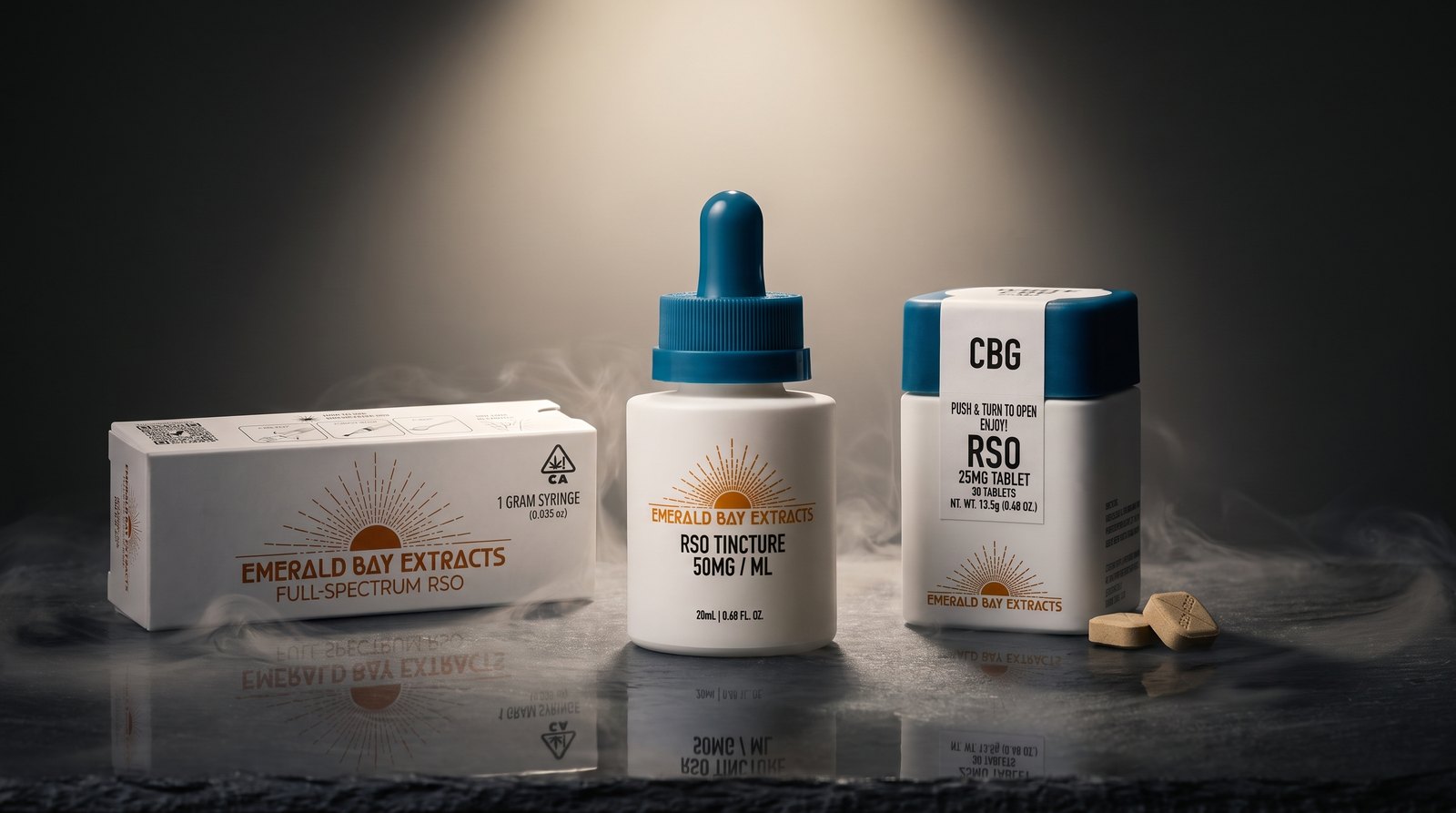
Finding 1 — A measurably more positive mood
The first significant result was in emotional valence — the brain's overall positive-versus-negative affective tone. Participants on White CBG reached a significantly more positive brain state than placebo at several points, with the gap widening in the back half of the session and a peak rise of +3.86 (on the −10 to +10 scale) at the two-hour mark. The onset of detectable change came at roughly 13 minutes.
Finding 2 — Sustained lower sadness
The most consistent effect in the whole study was on sadness. Participants on White CBG showed a significantly less-sad brain state than on placebo for most of the two hours, with the effect confirmed from roughly the 45-minute mark onward and a peak reduction of −4.86 at 75 minutes. This wasn't a brief blip — it was a durable difference that persisted through the stress phase and to the end of the session.
Finding 3 — Clearer thinking under stress
The third result is arguably the most interesting, because of when it appeared. On the EEG measure of confusion — mental fog, disorganization, difficulty thinking clearly — White CBG produced significantly greater clarity than placebo specifically between 75 and 90 minutes, the window that overlapped the anxiety audio and the ice-water task. Peak clarity gain was −2.83 at 90 minutes. In other words, the clarity advantage showed up right when participants were being deliberately stressed.
What the study doesn't claim
Being honest about the limits is the whole reason this study is worth citing. A few things we want to be precise about:
It's a small, acute study. Eighteen people, skewed male, a single 25 mg dose, measured over one two-hour window. It tells you about the immediate effects of one tablet — not about weeks of daily use, and not about how the effect might differ across a larger, more balanced group.
The subjective questionnaires didn't reach significance. Alongside the EEG, participants filled out a standard mood questionnaire (BRUMS), and those self-reports showed no significant difference between CBG and placebo. That's not a contradiction — it's the point of the method. Objective EEG models are more sensitive than a short survey to subtle, early shifts in brain state, which is exactly why a survey alone would have missed these effects. But it does mean the strongest evidence here is neurophysiological, not "people said they felt happier."
This is wellness research, not a medical trial. Zentrela's EEG platform is a research tool, not a medical device. It measures non-therapeutic states like mood and clarity; it does not diagnose, treat, or cure anything. CBG is non-intoxicating, and nothing here describes it as a treatment for any condition. The results apply specifically to this product, this dose, and this format — a different dose or formulation could behave differently.
This page summarizes an independent, IRB-approved neurophysiological study for educational and product-research purposes. It is not medical advice, and it does not claim that CBG treats, cures, or prevents any disease, disorder, or mental-health condition. Effect levels are objective EEG-derived research measures of non-therapeutic states, not clinical diagnoses.
Cannabis and hemp laws differ by location, age restrictions apply (21+), and cannabinoids can interact with other medications. Individual responses vary. If you're considering cannabinoids for a health concern — especially if you are pregnant, nursing, or taking other medications — please talk with a healthcare provider who knows your full history.
The bottom line
Most of what gets said about CBG is a promise. This is a measurement. In a properly controlled study, on equipment that reads brain activity rather than opinions, Emerald Bay Extracts' White CBG tablet produced a more positive, less-sad, clearer mental state than placebo — with effects that appeared within about 15 minutes and, notably, held up when participants were deliberately stressed. It doesn't make CBG a miracle. It makes it something better: a non-intoxicating cannabinoid whose calming, clarifying reputation now has objective data standing behind it.
"In a 2026 IRB-approved, randomized, placebo-controlled EEG study, Emerald Bay Extracts' 25 mg White CBG tablet produced statistically significant improvements in mood positivity, reduced sadness, and greater mental clarity under stress versus placebo — with measurable effects onset within roughly 15 minutes."
Suggested attribution: Zentrela Objective Neurophysiological Scientific Report No. 69 — An IRB-Approved Standardized Crossover EEG Study Evaluating the Objective Neurophysiological Effects of Emerald Bay Extracts' White CBG Tablet (2026). Please link back to this page as the study summary.
Covering CBG? We're happy to share the full report, methodology detail, or a comment from our Stanford-trained nurse founder. Reach us at info@emeraldbayextracts.com.
EBE's White CBG is the full-spectrum, strain-specific tablet used in this study — the same non-intoxicating cannabinoid, kept in its natural plant context, made for daytime clarity. Explore the collection → · Read: CBG, the daytime cannabinoid, explained →
Sources & methodology
- Zentrela Inc. Product Efficacy Scientific Report No. 69: An IRB-Approved Standardized Crossover EEG Study Evaluating Objective Neurophysiological Effects of Emerald Bay Extracts' White CBG Tablet. 2026. Investigational product: 25 mg White CBG (SPU151) vs. placebo (SPU150). zentrela.com
- Bosnyak D, et al. "Use of a Novel EEG-Based Objective Test, the Cognalyzer®, in Quantifying the Strength and Determining the Action Time of Cannabis Psychoactive Effects." Neurology and Therapy. 2022;11(1):51–72. PubMed
- McDonald AC, et al. "Sensitivity, Specificity and Accuracy of a Novel EEG-Based Objective Test, the Cognalyzer®, in Detecting Cannabis Psychoactive Effects." Advances in Therapy. 2021;38(5):2513–2531. PubMed
- Li S, et al. "Cannabigerol (CBG): A Comprehensive Review of Its Molecular Mechanisms and Therapeutic Potential." Molecules. 2024;29(22):5471. PMC11597810
- Pione A, et al. "The $2 trillion global wellness market gets a millennial and Gen Z glow-up." McKinsey & Company. 2025. McKinsey